The Road That Came With Proof
Customer
WATCO (Water Corporation of Odisha)
Sector
Water · Urban Utility · Government
Location
Odisha, India
Scope
120 km distribution network · NRW analytics · Automated billing
Cognecto modules
Boson + Cortex · Smart Water solution
Status
Active deployment
The Challenge
Water lost. Location unknown. NRW above 50%.
Non-revenue water was WATCO Odisha's single biggest operational cost — at over 50% of total production, more than half of every litre treated was being lost before it reached a paying consumer. The utility knew water was being lost. It did not know where, how much per zone, or who was responsible.
The conventional response — physical leak surveys, manual meter reading, periodic spot checks — had been running for years without meaningful improvement. The data needed to identify where losses were occurring did not exist in a structured form that could drive prioritised field action. Billing disputes were a daily occurrence. Public trust in the utility was eroding.
- NRW above 50% — half of every litre treated lost before paying consumer
- Loss location unknown — could not prioritise field investigation
- Manual meter reading — billing accuracy and consumer disputes worsening
- No DMA-level water balance — losses invisible at zone granularity
- Public trust eroding — utility reputation at stake
The Cognecto Solution
A knowledge graph of every pipe segment. A water balance for every zone.
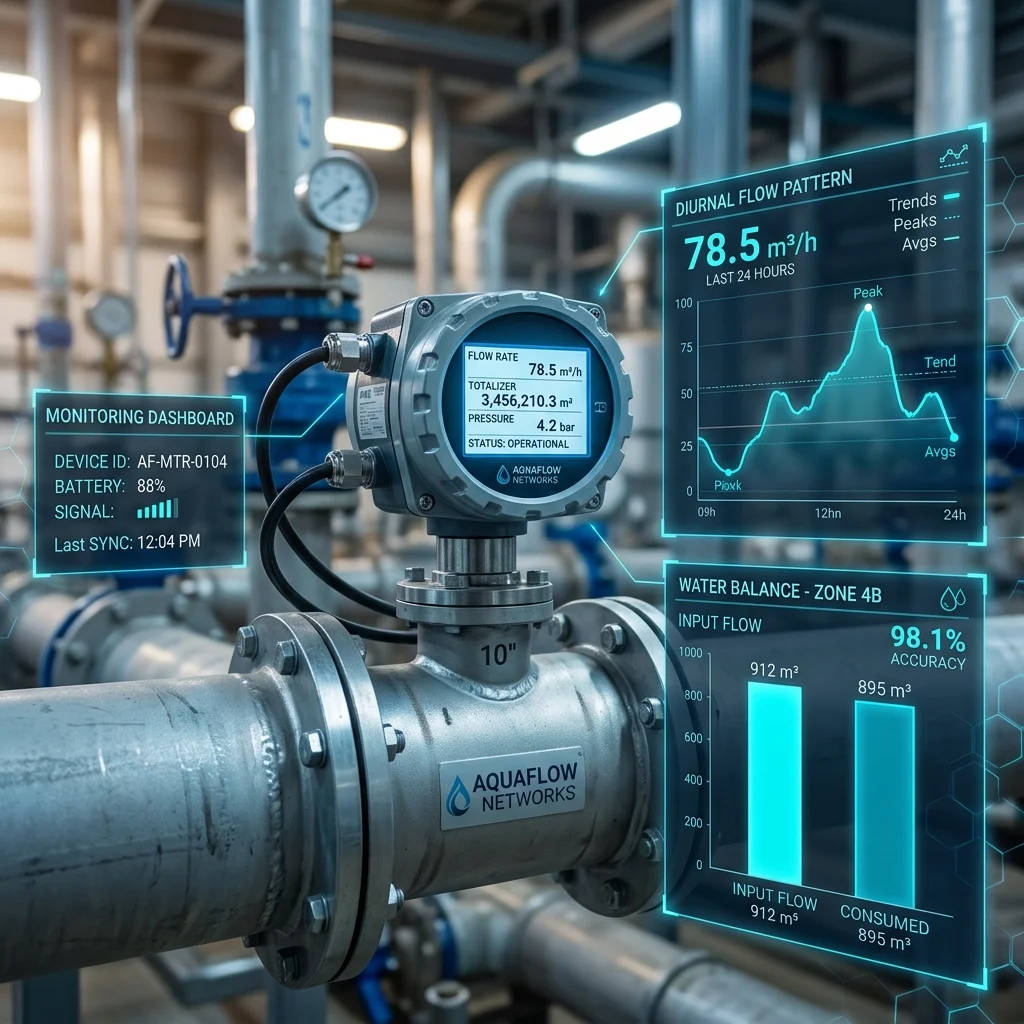
Cognecto deployed AMR smart metering, segmented the 120 km network into District Metered Areas, and built a Cortex knowledge graph linking every sensor reading, every consumption anomaly, every billing discrepancy to the pipe segment and district it came from. NRW was no longer a single percentage — it was a map of loss severity per zone, ranked by intervention value.
DMA-Level Water Balance
Inlet flow per zone vs sum of consumer meters — continuous loss calculation at zone granularity.
Minimum Night Flow Analysis
Smallest flow at 2-4 AM isolates background leakage from commercial losses — pinpoints true infrastructure losses.
Automated AMR Billing
Every meter read automatically — slab tariffs applied, bills generated and dispatched via SMS/WhatsApp/app.
Consumer Self-Service
Consumers view consumption, pay bills, raise complaints from app — billing dispute volume crashed.
Tamper & Leak Alerts
Reverse flow, magnetic interference, sudden flow spikes detected and dispatched to field service automatically.
Public Trust Recovery
Consumer-facing transparency on consumption and bills rebuilt utility-consumer relationship.
The Impact
"NRW fell 34% in the first six months. Billing accuracy improved 28%."
Both outcomes from the same data, structured correctly for the first time. The water network at WATCO Odisha did not change. The infrastructure did not change. What changed was the data layer underneath — and the operational decisions that data made possible. Non-revenue water dropped from over 50% to under 20% within six months. Revenue recovery was substantial.
−34%
NRW reduction · six months
+28%
Billing accuracy improvement
120 km
Network under Cortex knowledge graph
Daily
Water balance per DMA — continuous monitoring
Zero
Manual meter reading required
Recovered
Consumer trust through self-service transparency
"Non-revenue water was our single biggest operational cost. We knew water was being lost — we did not know where, how much, or who was responsible. Cortex built the knowledge graph of our network: every sensor reading, every consumption anomaly, every billing discrepancy linked to the pipe segment and district it came from. NRW fell 34% in the first six months. Billing accuracy improved by 28%. Both outcomes from the same data, structured correctly for the first time."
WATCO Odisha · Urban Water Distribution · Odisha, India